Showing posts with label consumer electronics. Show all posts

Wednesday, 8 December 2010

Legacy’s cost


“Number 2 is just the first one of the losers”, says a very famous motorbike racer who has been World Champion many times (still not retired) who loves being the fastest one.

This would be too radical a view when we have a look to any market, where there is not just one winner. It would actually be impossible under antitrust regulations.

However, the quote from Valentino Rossi (which is the biker’s name, as many bike fan’s might have guessed) can be understood in the context of what is currently going on in the smartphone market (and eventually in the tablet’s too), where old kings are running the serious risk of being phased out from their former positions.

Of course there can be space for them, and we actually believe there will always be, in fact. But it is really hard to accept being below second rank after past history dominance.

RIMM, Nokia, though still hitting very important volumes, might well be in that situation. The issue is the trend, clearly decaying, and the chance that they still base their current results on legacy. .

Legacy of corporate business and systems that have an enormous cost of change. Legacy of users who are provided a phone by their companies that might be used for personal purpose. Legacy from past experiences and resistance to adapt to new phones from previous ones.

But legacy has a deadline and does not last forever. History proves legacy is not enough, and costs empires. Ask the British about India, ask the French about Indochina, ask the Dutch about their Indies, or ask the Russians for the “xxxstan” republics. there is still a Britain, a France, Netherlands and Russia… but where did their empires go?

The sound of silence


It is common to hear that no news equals good news… but it does not really seem the case for the guys at Microsoft regarding their mobile phone story.

Silence, as in that famous tune by Simon and Garfunkel, can be really loud, even more than the cheerful reporting when success is there, like it happened with Kinect.

Silence as well about the potential upgrades that are badly needed does not help either. When will the famous “cut & paste” basic feature show up?

The more they wait, the smaller chunk of the pie they’ll get, though they still have the potential benefit from the corporate and enterprise market, that to much extent has a Microsoft based IT. But even there, RIMM and Nokia can be too far it they keep on slowing down, or if they fail to move fast. Even the slowest of the slowest, that is, Palm, might move ahead of them if they ever start. Particularly if they deliver a confusing message to this segment.

The market does not wait for sound names and brands if they do not really deliver.


Wednesday, 1 December 2010

Teenagers buy too


Political systems that determine what party holds government for a certain period of years are based on people’s votes. Every number of years, elections are set up, and the party that gets the higher number of votes holds government until next election.

If voting age starts at, say, 18, a significant portion of voters in elections happening in year 2020, for example, will include a lot of new voters who were under age in the previous polls. Let’s use the US as an example.

When presidential elections come up in 2012, all the people who are today from 16 to 19 will be able to vote for the first time in their lives. So Republicans or Democrats that prepare those elections should consider all these teenagers as prospect voters and make sure they buy in even before they become actual voters.

And here we got another smart move from Apple, according to the report here… If the information delivered in it is correct, it would be a fact that Apple is not only selling well to current customers, but as well paving the way for maintaining and/or increasing its share in the smartphone and tablet markets at least in the future. The tablet market, predicted to grow real fast, will be based on current customers, but new ones that today are just teenagers that will have resources to buy stuff in the coming years.

Maybe they have to wait long for 6-year-old kids to be real customers, but the same principle applies to teenagers that will have enough money, or that can convince mom and dad to get one iPad or iPhone for them next year, or in 2012.

It is not frequent, for example, to find teenagers longing for a regular mp3 player, a specific Android phone or even a Zune or a Windows Phone 7 phone. But they actually do for iPhones, iPods or iPads. Not necessarily because of games… but more because of all the rest of things you may do with it in a recognizably “cool” way.

Skating, for example, is not that much about moving a certain distance differently than just walking or running. Is about stepping on a fashionable board and doing weird movements on it and with it while managing to keep balance and not getting hurt. Same with tablets or smartphones. It is more about how you do things on them than the actual things you do, which could be performed in a standard laptop or netbook.

Tuesday, 30 November 2010

Der Volkscomputer (II)


After WWII, once French automotive industry got rid from the German occupation authorities, they followed the Volkswagen concept.

Citroën launched its 2CV model, based on the same principles as the Volkswagen Beetle. It went even a bit further in its austerity. For example, it got just one headlight, for pure cost savings and simplicity. As the Germans in the 1930s, France after 1945 was in badly need for economical recovery.

If iPads or iPhones are the leading concept, the Volkswagen of our times, we guess we could say Citroën’s 2CV follow as the Androids came after the iPhones…

alt


Monday, 29 November 2010

Der Volkscomputer


Back in the 1930s, Germany was in the middle of its reindustrialization as a necessary step to get ready for the war that was already cooking in Hitler’s mind. Besides the reinforcement of the pure military industry, there was a strong recovery of the country’s economic infrastructure, what meant not only basic industry, but communications too. The plan for “die Deutsche Autobähne”, the German highways network was being deployed to.

In coordination with this, the German government of the time decided as well that the automotive industry should as well be a fundamental part of these plans, including the production of a cheap car that could be afforded by the average German family. That was the birth of one of the automobile industry icons: The Volkswagen Beetle. In fact, that is what Volkswagen meant: A car for the people, for the folk. Cars manufactured at that time were really expensive for an average German, who saw Mercedes, Opel, Maybach or BMW as unreachable items. The Great Depression of 1929 or the recovery from WWI were still too high economic loads for German citizens.

Incidentally, we shall mention that the industrialist awarded the necessary support to fulfill the project was Ferdinand Porsche. Curiously enough, we think nobody would associate the name Porsche to an average car for an average citizen in an average country, would they?

Despite the progression of WWII, still after the war the Beetle was there, and it did hit the right combination of price, market segment and product features. It was the right product at the right place in the right time to become an industrial success.

Not as powerful and fancy like Mercedes, Alfa Romeo, Citroen, Opel, Ford, Buick, Oldsmobile or Chevrolet; not as expensive either, it still was enough: Four wheels at a reasonable price that made the car acceptable for basic transportation needs, and was relatively easy and cheap to produce too. Factories were set up in Brazil, Mexico and China.

Later on, it even became fashionable: It’s typical and unique design (unchanged for decades!) came to a point in which it was perceived as cool, fancy and stylish. Not only it became an icon for the industry, but as well for a full generation of users. Even there have even been “revival editions”, special batches with this or that feature, that have been sold as limited series, with real high prices and margins.

It has been one of the best selling cars worldwide. To the point, in fact, that starting from the Beetle, a full line up was developed under the Volkswagen name, which, after having been a name designated to one specific car, has turned into a worldwide brand, and in fact, a worlwide industrial company. The Volkswagen brand is in fact one of the best recognized brands in the whole world, similar to Coca-Cola, General Motors, IBM or other. Under the Volkswagen brand, there are no more Beetles in production, but there are Golfs, Jettas, Passats, Touareg SUVs, trucks, minivans… and the industrial group own other brands such as Audi, Skoda, SEAT…

It looks that iPads are indeed repeating the Volkswagen story. For some, iPad turns to be the affordable Mac. If Mac is a Porsche, iPad is the Beetle… and Ferdinand Porsche himself has re-incarnated in Steve Jobs!

But as we write this, we even think the story goes further… we think the very first affordable Mac was the iPod/iPhone duo. That was indeed the very first Beetle, the first Mac experience for many people. As a matter of fact, would it be false to say that iPad’s success is based on the iPod’s or on the iPhone’s? And isn’t Mac Pros, Mac Airs as well benefitting from the halo of iPads?

Apples to apples


We have read an interesting summary of an analysis made on smartphone users’ loyalty to the brand of their current handset.

The conclusions driven there seem reasonable, though we believe one should be cautious when drawing conclusions.

We think the smartphone market, booming these days, might change a lot in short time, so many things are still developing and reaching users as we write this, that today’s conclusions may be completely different in a few months from now.

If loyalty is a reflection of satisfaction, we’d still need to define how satisfaction is measured. We still need to be clear about what it really means to the user. It is not the same thing a professional that has been given a Blackberry by his employer, for example, to use it for professional email and SMS than a university student that basically might want his phone for chatting, web browsing and facebook logging.

To measure satisfaction, one would need to know the cost a given product has meant to the user, and the expectations he really had about what he got. If we were given a smartphone for the first time for free by an employer of ours, which allowed us to do email on-the-go (assumed our previous phone did not allow us to), we would be very happy with that, regardless the OS (Android, IOS4 or Symbian, for example), especially if it is our company that pays the bill. We would not be more loyal to the handset brand than however loyal our employer were.

As well, if we were to use a Windows Mobile phone after having had an iPhone or Android, our satisfaction/loyalty would be seriously reduced…

As well, there are many factors that can influence user satisfaction or loyalty which might not depend on the handset you are using, nor the OS it supports. What about the carrier service, possibilities or limitations? What about its service plan, the cost of it? For some customer segments, it might be as well important the brand perception or how “cool” might a given device look or feel. We know of many cases where teenagers ask mom and dad for a Blackberry just because mom or dad use one, or just because the most popular mates at school have one each, for whatever reason.

Hard to measure loyalty or user satisfaction, and hard to extrapolate results for predicting future volumes or sales.

We see the current smartphone market more like the case of the youngster that recently got his car driver’s license for the first time. The prospect of moving from being a bike user to driving a car on his own is so exciting to him that he will be the happiest person in the world to have his car, no matter if it is a brand new convertible Ferrari sportscar, or mom’s 20-year old Volkswagen, that she recently replaced by a new one. At the end of the day, both cars open for the kid a new world of possibilities, one way or another, that were so far inaccessible to him.

In a market so much subject to change in very short time frames, conclusions from this kind of surveys should then need to be very carefully managed and understood, we think, making sure one compares “apples to apples” to make those conclusions really valid or useful. By the way, those who prefer Blackberry might prefer to compare “berries to berries”…

Sunday, 21 November 2010

Criticism and pain


When facing his government duties, Sir Winston Churchill said once: “Criticism is as necessary as pain; it reminds us that something is not going well and needs attention.”

More than a mere critical opinion or a different point of view, facts can be a much louder or stronger criticism. As such, it should probably be paid, therefore, more attention.

And for the moment, Sony Ericsson’s decision to not introduce smartphones with Windows Phone 7 is a fact.

There has been a lot of opinions back and forth, for and against Microsoft’s phone operating system… but so far, besides it’s poor performance in sales (as far as we have known), we have not seen a harder one.

If the fourth largest worldwide handset manufacturer says “no”, this is a serious warning to Ballmer’s boys. Especially if they have androids there, as reported in the link above.

Opening new stores may not be enough.

Giving free tickets for pop concerts might be useless.

Playing Incrediboy might not suffice.

Not caring for your developers might backfire.

Leaving it all to a wizard at the end of a yellow brick road may mislead.

Taking everything for granted does not solve problems.

If one treatment does not work, it is useless to repeat it to heal the problem.

and, definitely, we would not put the solving of our pains in the hands of apes.

Too many pain symptoms to avoid facing them, we believe.

Flaming balloons


By the end of the 19th Century, the German started developing balloons for military purposes. We could consider this milestone, together with the use of reconnaisance balloons during the American Civil war as the very early stages of modern air forces.

Despite the progress made since then until the late 30s, when classical planes had consolidates its dominance in the air, and when helicopters were beginning to have their earliest realistic prototypes, it was clear before 1940 that balloons had reached a dead end. The Hindenburg disaster in 1937 was the final chapter of its brief history.

Conceptually speaking, the defenders of the balloon industry used the principle of “best of both worlds” to insist in developing that industry. Static possibilities, later developed factually with helicopters, combined with actual mobility like in the classic planes, combined with its very low cost compared to the other models.

Caught halfway between the two flying models, there was no room for balloons.

In a brave attempt to bridge the gap between today’s two main trends towards easy, affordable computing ultra-mobility (netbooks and tablets), Dell is about to launch their Inspiron Duo device.

In our opinion, we are basically talking of an original design that combined the features of both types of devices, tablets and netbooks, and there is some praise about the possibility of getting the best of both worlds.

However, we see a bigger risk in getting caught halfway between both worlds, or, if you’d prefer, getting the worst of both worlds. Few advantages, all the disadvantages, that is.

Besides the clear disadvantages pointed out in the reference news, we see some more:

First, the flipping screen, as a movable part, can be sensitive to hardware failure. The less the mobile parts the better, for reliability. What takes us to the second item.

Second, though flash storage is a plus compared to standard disks with moving parts in terms of reliability, its increased capacity is not really a significant advantage, for netbooks and tablets are more and more oriented to online content that is stored in the “cloud”, not necessarily in a local disk.

Third, its operating system, as it is today, is not a rival for tablets in particular, powered by androids and iOS much more successfully than whatever Windows might be doing. Just look at market data for units already shipped, or to market predictions.

Fourth, having a keyboard (supposedly demanded by customers) is not really such an advantage. Millions of customers, using same figures as in previous item, are clearly NOT demanding such a keyboard, which adds cost, weight and technical complexity.

Fifth, a significant value for tablets, regardless of its OS, is the AppStore behind them. Microsoft is way behind Apple and Google, isn’t it?

Sixth, long-term financial viability. Even if Dell makes an initial success, following the “Qualdroid” business model does not guarantee financial success to them. The “Wintel” model proves so.

Seventh, as well related to Dell’s financials, they are starting from a very weak position at this moment that might not help at all in sustain the time it might take for this Inspiron thing to take off. Maybe they are diverting their consumer portfolio too much, with Streak, Inspiron, mobile phones…?

In praise of Dell we could say it is always good to try new things and move forward with innovation… but we do not really see a major chance here. Not to kill iPads nor Androids at least, Inspiron Duo might blow up like the Hindenburg did.

Friday, 19 November 2010

Incrediboy’s Syndrome


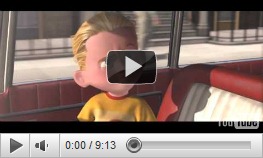
Lovely story the one in The Incredibles movie, wasn’t it? Everybody can easily recall the glory days when Mr. Incredible, on his own, was carrying on his war against evil. Alone.

Focus on minute 4…

So admired was he that one of his fans, a young teenager, wanted to emulate him. Incrediboy was the name the kid chose, and gallantly offered his services to Mr. Incredible who bitterly rejected the offering. “I work alone”, said he.

Incrediboy was pissed off and seriously outraged, to the point that years later, when superheroes had been called off, he had amassed an enormous wealth and power to turn himself into the most fearful super-villain ever, Syndrome by name. Rejected by superheroes as a teenager, he had turned to the opposite side, and changed his personal aims to end up with any trace of past superheroes and end up dominating the world, as all decent super-villains usually do, of course.

I would say everybody knows how the story ended.

But now we have the modern version of Incrediboy trying to imitate superheroes again… True that todays Incrediboy looks more like the retired Mr. Incredible before he resumed his past glorious times, but still an Incrediboy with a big big big post traumatic stress syndrome…

He as well tries once and again to be like his hero… and his hero kingly ignores him once and again…

Being like this as Incrediboy, we resist ourselves to imagine how he’d be like as Syndrome.